
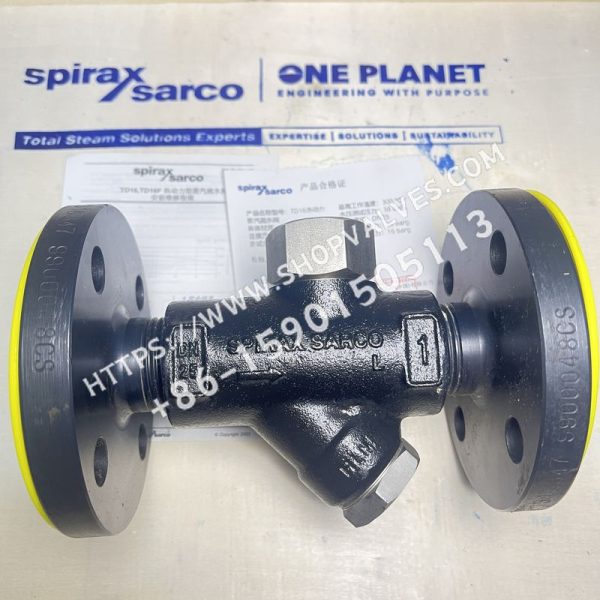
Description
Spirax Sarco TD16 and TD16F thermodynamic steam traps are designed for low-capacity steam mains, tracing lines, and other applications within their pressure, temperature, and capacity limits. Maximum operating pressure is 16 bar g.
Available Models
| Model | SKU |
|---|---|
| DN15 TD16 | 1510015002 |
| DN20 TD16 | 1510020002 |
| DN25 TD16 | 1510025002 |
Limiting Conditions
| Maximum Body Design Condition | PN 25 |
|---|---|
| PMA - Maximum Allowable Pressure | 25 bar g |
| TMA - Maximum Allowable Temperature | 300 ℃ |
| PMO - Maximum Operating Pressure | 16 bar g |
| TMO - Maximum Operating Temperature | 300 ℃ |
| Maximum Cold Hydraulic Test Pressure | 38 bar g |
Note: Under operating conditions, the maximum operating backpressure must not exceed 80% of the inlet pressure. Otherwise, the steam trap will not close.
Sizes and Pipeline Connections
-
TD16F: DN15, 20 and 25, PN16 flanged connection
Materials
| No. | Part | Material |
|---|---|---|
| 1 | Body | Stainless steel ASTM A743.Gr.CA40F |
| 2 | Cap | Stainless steel AISI 416 |
| 3 | Disc | Stainless steel BS 1449 420 S45 |
| 4 | Strainer screen | Stainless steel BS 1449 304 S16 |
| 5 | Strainer cap | Stainless steel AISI 416 |
| 6 | Strainer cap gasket | Stainless steel BS 1449 304 S16 |
| 7 | Insulating cap (optional) | Aluminum |
| 8 | Flange | Carbon steel |
Dimensions (Approximate) and Weights
| Size | Weight |
|---|---|
| 1/2” | 0.75kg |
| 3/4” | 0.95kg |
| 1” | 1.50kg |
| DN15 | 1.95kg |
| DN20 | 2.65kg |
| DN25 | 3.90kg |
Options
-
Insulating cap: The insulating cover helps prevent excessive heat loss from the steam trap in low-temperature, windy, and rainy conditions, reducing overly frequent cycling.
-
Integral blowdown valve: Refer to TI - P153 - 01. A 1/4”BSP threaded hole can be drilled in the strainer cap for installation of a blowdown valve.
Installation
Horizontal installation is preferred, although the trap may also be installed in other positions.
Ordering Information
Example: 1 - Spirax Sarco TD16 thermodynamic steam trap, 1/2”BSP screwed connection.
Ordering Spare Parts
Order spare parts according to the descriptions in the spare parts table, specifying the steam trap model and size. Example: strainer screen and gasket for a 1/2”TD16 thermodynamic steam trap.
Maintenance
-
Before performing any maintenance work, make sure the isolation valves upstream and downstream of the steam trap are closed, the pipeline is depressurized, and the steam trap has cooled to room temperature.
-
Disc and seat maintenance: If an insulating cap is installed, remove it first. Use a standard wrench to loosen the cap, taking care not to use an adjustable wrench or pipe wrench, as this may damage the cap. If the disc and seat surfaces are only slightly worn, use lapping compound and lap the disc and seat separately using a figure-eight motion. If wear is too extensive to be repaired by lapping, machine and polish the seat surface and replace the disc with a new one. Lapping must not remove more than 0.25mm. During reassembly, position the disc so that the grooved surface contacts the seat surface. Tighten the cap without a gasket, but apply a suitable high-temperature anti-seize compound.
-
Cleaning or replacing the strainer screen: Loosen the strainer cap with a wrench, remove the screen, and clean it. Replace the screen if it is damaged. During reassembly, insert the screen into the cap and then screw the cap into the valve body. Apply a small amount of molybdenum disulfide lubricant to the leading threads, make sure the gasket surfaces are clean, and finally tighten the strainer cap to the recommended torque.